


NEWS

 Industry News
Customer Achievement | Non-volatile programmable directional couplers for high-integration and low-loss photonic computing
Article:
Non-volatile programmable directional couplers for high-integration and low-loss photonic computing
Original link:
https://doi.org/10.1364/PRJ.582627
Equipment Model:
Goldenscope Tech's Pharos 310 e-beam lithography
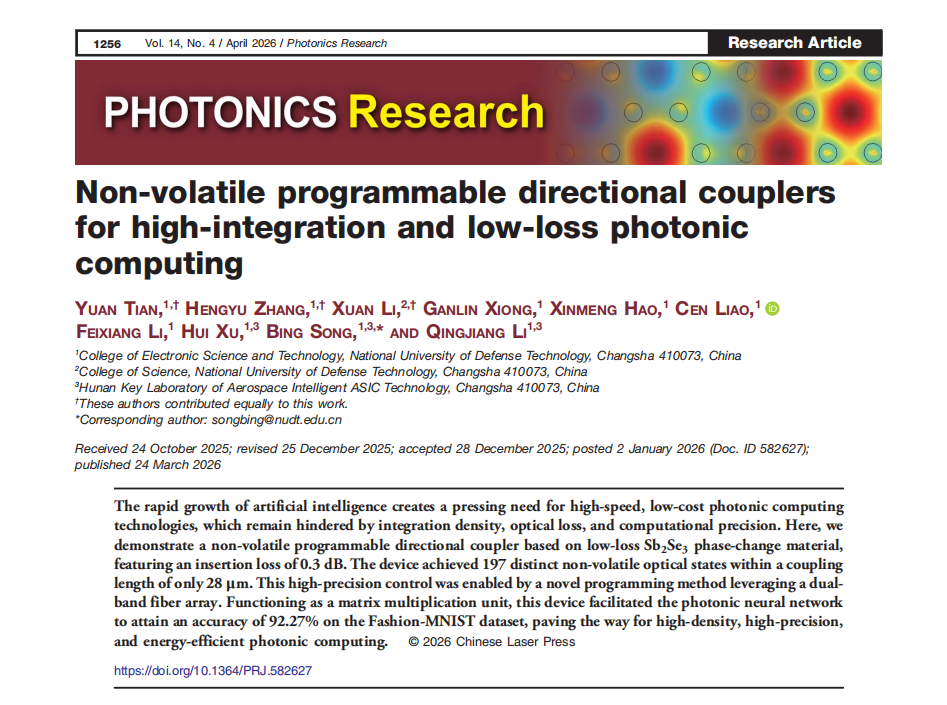
The rapid growth of artificial intelligence creates a pressing need for high-speed, low-cost photonic computing technologies, which remain hindered by integration density, optical loss, and computational precision. Here, we demonstrate a non-volatile programmable directional coupler based on low-loss Sb₂Se₃ phase-change material, featuring an insertion loss of 0.3 dB. The device achieved 197 distinct non-volatile optical states within a coupling length of only 28 μm. This high-precision control was enabled by a novel programming method leveraging a dual-band fiber array. Functioning as a matrix multiplication unit, this device facilitated the photonic neural network to attain an accuracy of 92.27% on the Fashion-MNIST dataset, paving the way for high-density, high-precision, and energy-efficient photonic computing.
Introduction
Programmable photonic integrated circuits (PICs) have emerged as the next-generation core hardware platform, breaking through the traditional von Neumann architecture, thanks to their high-speed on-chip optical signal processing and massive parallel processing capabilities. However, traditional thermo-optic/carrier dispersion phase shifters suffer from weak refractive index modulation capability (Δn<0.01), leading to large device sizes and the need for continuous power supply to maintain their state, which severely restricts system integration and energy efficiency.
Phase change material (PCM) photonic phase shifters exhibit nanosecond-level switching speed and high phase control efficiency. However, classic materials such as GST and GSST suffer from issues like high light absorption in the crystalline state and high loss. In contrast, Sb₂Se₃ exhibits a high refractive index difference (Δn=0.76) and an ultra-low extinction coefficient (k≈10⁻⁵) at the 1550nm communication wavelength band. Its light absorption loss is negligible, and its non-volatile nature eliminates the need for static power consumption, making it an ideal material for low-loss photonic computing.
The Tunable Directional Coupler (TDC) is a core device in photonic integrated circuits, offering advantages over traditional Mach-Zehnder Interferometers (MZIs) in terms of compact size and higher sensitivity. However, existing directional couplers have a limited number of tunable states, and electrical control suffers from thermal residuals leading to state drift and insufficient accuracy. Spatial light control is also challenging to integrate on-chip. Therefore, there is an urgent need to develop photonic devices that simultaneously meet the requirements of high integration, low loss, and high programming accuracy.
In this work, Sb₂Se₃ is integrated with a silicon-based directional coupler to fabricate a compact non-volatile programmable directional coupler (PDC) with a coupling length of only 28 μm. In-situ high-precision programming is achieved through a dual-band fiber array, obtaining 197 optical weight states. The photonic neural network constructed based on this device achieves a recognition accuracy of 92.27% on the Fashion-MNIST dataset, verifying its potential for application in high-density photonic neuromorphic computing.
Results and Discussion
A. Design Principle for Compact and High-Bandwidth PDCs
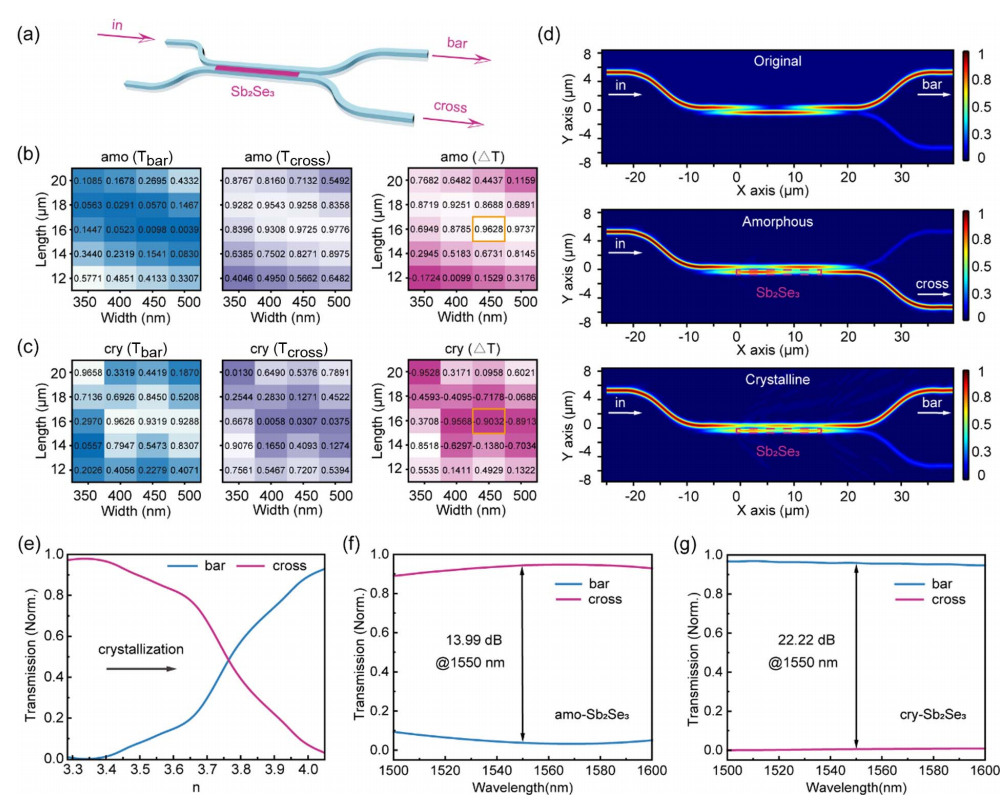
Fig. 1. Design of a compact programmable directional coupler based on low-loss PCM.
B. High-Quality Heterogeneous Integration of Low-Loss PCMs on a Single-Sided Coupling Waveguide
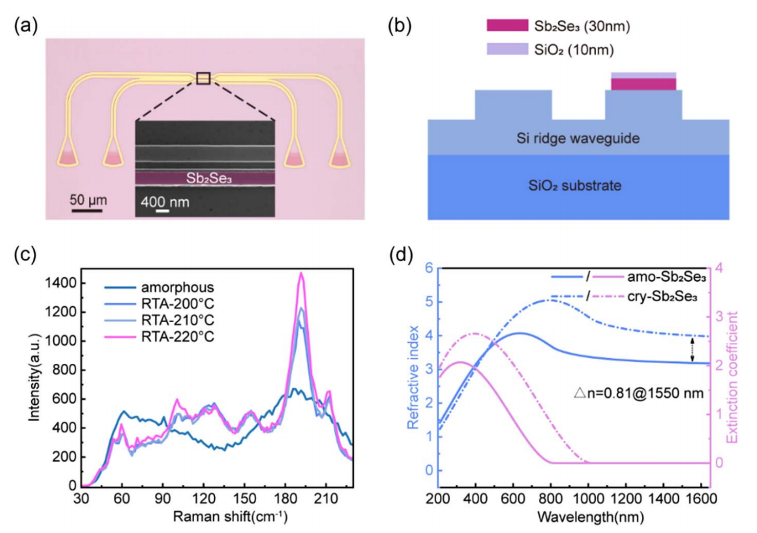
Fig. 2. Experimental realization of a programmable directional coupler based on Sb₂Se₃.
C. High-Precision Optical Programming of PDCs Based on Dual-Band Fiber Array
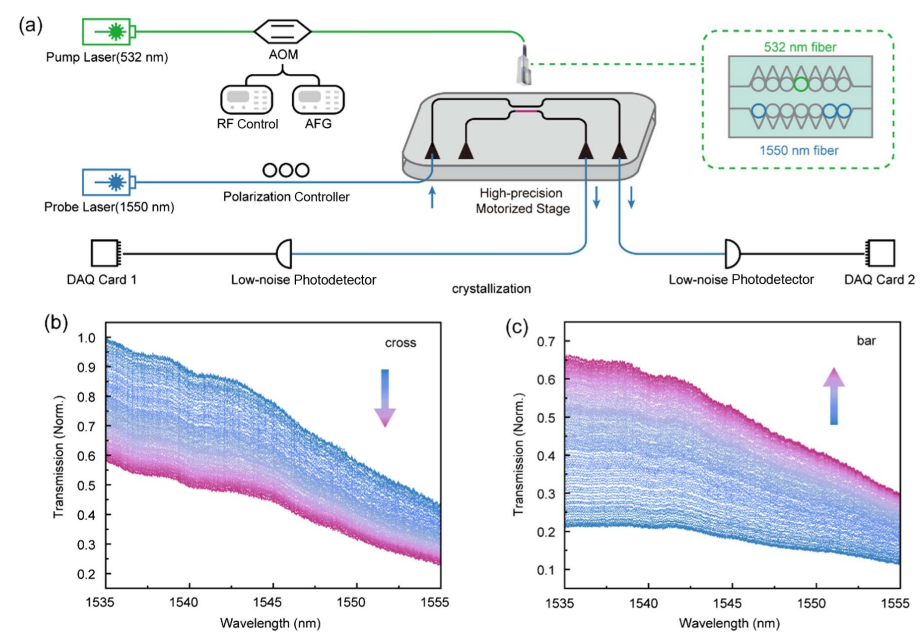
Fig. 3. High-precision integrated programming solution for the programmable directional coupler.
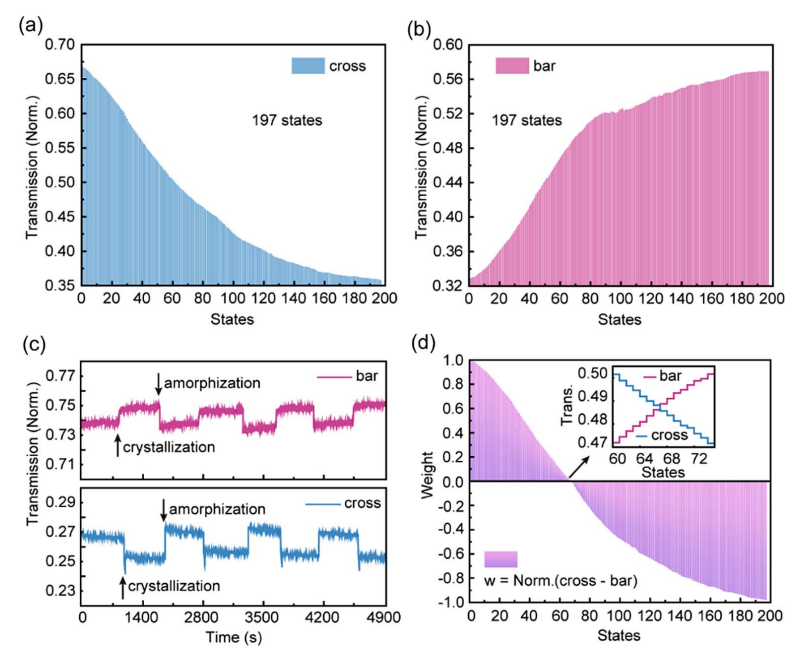
Fig. 4. High-precision programming of the programmable directional coupler.
D. Photonic Convolutional Neural Network Based on PDCs
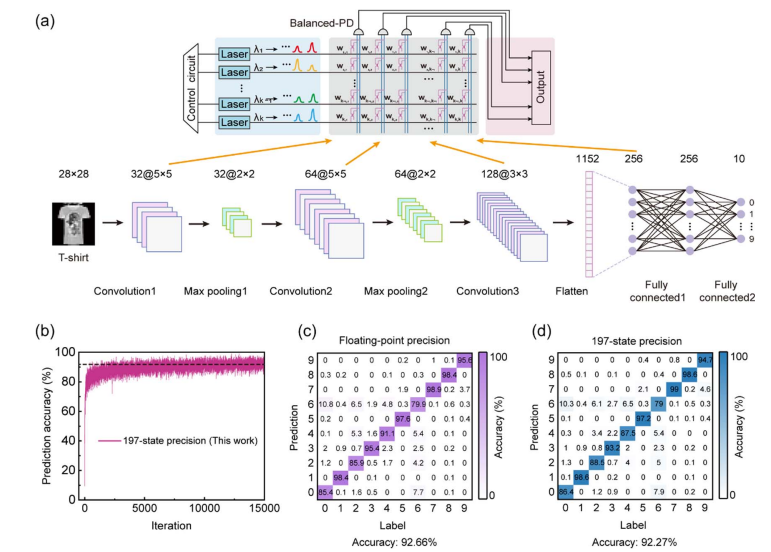
Fig. 5. Photonic convolutional neural network architecture and performance.
Conclusion
Based on the low-loss phase change material Sb₂Se₃, this study has developed a highly integrated and high-precision programmable directional coupler. Through coupled-mode theory and 3D FDTD simulation optimization, the device features a coupling length of only 28μm and a phase change material length of 16μm. The ultra-compact size significantly enhances chip computing power and integration density, while reducing wavelength sensitivity and broadening the operating bandwidth, making it suitable for dense wavelength division multiplexing and parallel photonic computing scenarios. The low optical loss characteristics of Sb₂Se₃ can reduce the energy consumption of computational optics. Combined with the non-volatile nature of the phase change mechanism, the device can maintain its programmed state without requiring static power consumption, providing a new path for energy-efficient photonic computing.
Methods
A. Device Fabrication
(1) Waveguide fabrication: Using SOI substrates, ridge waveguides and grating couplers are fabricated through electron beam lithography (EBL) and ICP reactive ion etching;
(2) Phase change material deposition: After spin-coating the electron beam resist, the directional coupler single-sided phase change material pattern is defined using the Pharos 310 electron beam exposure system from Jin Jing Technology; a 30nm Sb₂Se₃ and 10nm SiO₂ protective layer are deposited by magnetron sputtering, and acetone stripping completes the device fabrication.
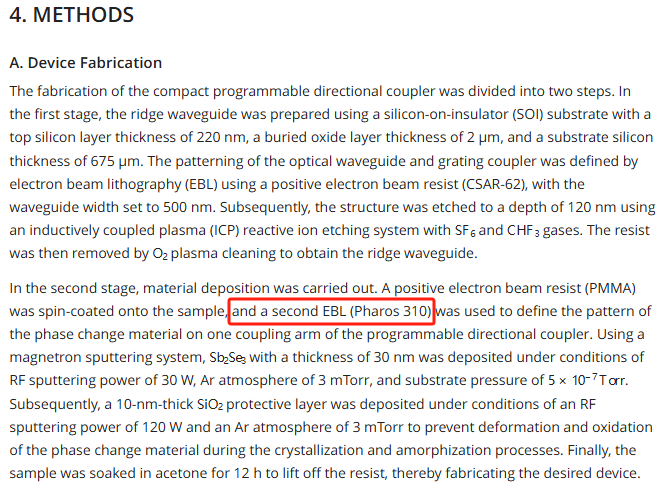
Image: Some experimental methods involving the Goldenscope Technology electron beam exposure machine (excerpt)
B. Measurement Setup
Using a 1545nm continuous laser as the probe light and a 532nm acousto-optic modulated laser as the pump light, the optical signal is coupled and input through a two-dimensional fiber array, and real-time monitoring is achieved by a low-noise photodetector coupled with a data acquisition card.
C. Convolutional Neural Network Setup
Using an improved deep CNN model, optimized for the Fashion-MNIST classification task, it is trained through stochastic gradient descent algorithm, with L2 regularization and data augmentation to prevent overfitting.
References:Y. Tian, H. Zhang, X. Li, G. Xiong, X. Hao, C. Liao, F. Li, H. Xu, B. Song, and Q. Li, "Non-volatile programmable directional couplers for high-integration and low-loss photonic computing," Photon. Res. 14, 1256-1266 (2026).





GOLDENSCOPE TECH GOLDENSCOPE TECH GOLDENSCOPE TECH GOLDENSCOPE TECH GOLDENSCOPE TECH GOLDENSCOPE TECH GOLDENSCOPE TECH GOLDENSCOPE TECH GOLDENSCOPE TECH GOLDENSCOPE TECH